Operations Management
Leadership
Artificial Inteligence

Artificial intelligence (AI) and ego can take two very different paths.
On one hand, people use AI to create slop for posts on social media. Too often, these posts take the form of cartoonish images – usually representing themselves as famous historical figures, or cultural icons, or as just more stylish and fit than they really are. Video slop is being created at a velocity surpassing the speed of sound.
While annoying, this egotistical use of AI doesn’t cause real harm. A worse problem is when people choose NOT to use AI because of their ego.
For example, programmers who reject AI tools that can assist with problems. Or researchers who refuse to use chatbots to learn more about a subject. Or consultants who won’t use AI to analyze data.
The rationalization to “opt out” of AI can take many forms. The programmer thinks their years of experience will produce better results. The researcher points out the constant reporting about hallucinations. The consultant claims that their approach is unique and can’t be replicated.
The illusion of self-importance is often tied to fear. Fear of change. Fear of uncertainty. Fear of not being irreplaceable.
A client’s chief information officer (CIO) talked about taking the opposite approach. Their team has to work with multiple legacy systems that can’t talk to each other. By building AI agents, they are able to extract relevant data in real time from disparate platforms, creating a unified, usable view.
Agentic AI wasn’t replacing his team, it was helping them create powerful solutions to support the business. Unsolvable problems are becoming solvable.
A focus on solutions and the proper tools – not ego – leads to success.
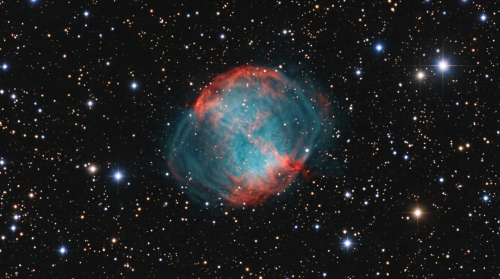
Amazing Astronomical Fact: There are no planets in a planetary nebula.
A planetary nebula is a glowing shell of gas created by a dying red star. The central hot core is also the densest part, as the outer layers are expanding gases. The term “planetary nebula” was used by 18th-century astronomers because through a telescope, the nebulae resemble planets.
The first planetary nebula was discovered by Charles Messier in 1764. Assigned the number Messier 27 (M27), it is also known as the “Apple Core Nebula” and the “Dumbbell Nebula”.
#artificialintelligence #ai #ego #aitools #agenticai #astrophotography #planetarynebula #theberkshirecompany

Missed a past newsletter? No worries they're all saved on our Thursday Thoughts on AI page.