
Artificial Inteligence
choosing
AI

While in college, I took several courses in computer programming. Although I was a history major, it was the 1980s, and I knew that computers were going to impact my career. I first took a course in BASIC programming and then one in Pascal.
As a person who enjoyed geometry and logic, programming made sense. That doesn’t mean it was easy. However, if I could figure out the right commands, I could write a program that would produce the same results every time. Anyone could read the code, and make changes to improve the program.
In the mid-1990s, I had the opportunity to work as part of a robotic process automation (RPA) project at an insurance company. Similar to what I learned in college, I wrote scripts that interacted with a claims systems. The script read an electronic invoice from a glass company, determined if the claimant had the correct coverage, and make the appropriate payment. The script could be read by another person, who could make changes to improve the program.
Artificial Intelligence (AI) engines work under an entirely different paradigm. This is due to the concept of Machine Learning (ML). This is a subset of AI where systems learn patterns from data without being explicitly programmed for each task. This means that the AI engine is changing the algorithm – the mathematical instructions or rules that guide how an AI system processes information and makes decisions.
In plain English, it means that the AI engine is rewriting the program that makes it work. By itself. Continuously. No human intervention. Hundreds, thousands, even millions lines of code being written every day.
That means no one actually knows how the AI engines actually work. We understand the concepts, but not the specific programs. When new “versions” of engines are released, the companies are only providing new features and interfaces. The underlying programs are being written by the computers themselves.
Only a small percentage of people truly understand the code that makes most software work. Just like only a small percentage of people understand any technology – cars, smart phones, streaming services or the internet. But we believed that there were humans somewhere who did understand how it worked and could make corrections or improvements.
In the world of AI, we are in unknown territory. We no longer know what we don’t know.
Amazing Astronomical Fact: Just over a hundred years ago, in 1924, Edwin Hubble proved that there were galaxies outside the Milky Way, starting with the Andromeda Galaxy. Today, we understand there are over 2 trillion galaxies in the observable universe, each with billions of stars.
The word “galaxy” comes from a Greek word for “milky circle”, and was used to describe our own galaxy, The Milky Way.
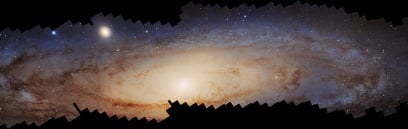
The image at the top of this post is a mosaic of the Andromeda Galaxy created by the Hubble Space Telescope.
#artificialintelligence #ai #machinelearning #rpa #galaxies #theberkshirecompany

Missed a past newsletter? No worries they're all saved on our Thursday Thoughts on AI page.