“Wealth is not his that has it, but his that enjoys it.” – March 1736
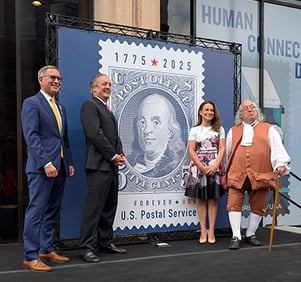
As we close the 250th anniversary year for the US Postal Service (USPS), we should remember that it is one of the longest enduring government institutions serving our citizens. Almost every day, almost every address in the country receives a visit from a letter carrier. These visits are part of the USPS “obligation to provide postal services to bind the Nation together through the personal, educational, literary, and business correspondence of the people.”
Ben Franklin recognized the importance of an effective and efficient public postal service. His reforms as Postmaster General under the British monarchy and the Second Continental Congress are still felt today. Franklin…
- personally surveyed and marked post roads, using an odometer on his carriage to measure distances and establish more logical and efficient routes.
- used night riders to cut delivery times between Philadelphia and New York.
- developed and implemented the first-rate chart, which established consistent delivery costs based on a letter's weight and the distance it traveled.
- devised a standardized system of ledgers and accounts for all local postmasters.
- encouraged postmasters to establish a service for delivering letters to their recipients’ homes for a small fee.
Franklin probably would be amazed at the changes over the past 250 years.
Planes, trains, trucks and e-vehicles move the mail. The USPS and mailers now use software to calculate distances, weights and delivery times. Point of sale systems record transactions at over 33,000 post offices. Commercial mailers use the Enterprise Payment System to pay for postal products and services. In addition to home deliveries, the USPS offers package lockers throughout the country.
The USPS Executive Leadership Team covers delivery, distribution, logistics, marketing, finance, information, technology and legal. Add to that the expansive rules and regulations to be followed when using the USPS. There are so many terms, acronyms and abbreviations, they require their own official publication. With 50 districts and hundreds of processing centers, mailers may not be sure who to contact for assistance.
Of course, the first place to start in 2025 is the internet. The official USPS website provides links for the general public and business mailers. Whether using Every Door Direct Mail, Click-N-Ship, placing mail on hold, or scheduling a pickup, a mailer can find a way to do that digitally. And that doesn’t include ordering stamps, t-shirts or other gifts from The Postal Store!
Business mailers looking for more detailed information have the Postal Explorer and PostalPro websites. From there, they have access to the Domestic Mail Manual, rate charts, technical documentation, and certifications. On the Industry Forum are alerts, events and links to the Mailers Technical Advisory Committee (MTAC), Areas Inspiring Mail (AIM), and the Postal Customer Council (PCC) programs. Each of those groups have webinar recordings on specific topics.
We also send our clients to the USPS Mailing & Shipping Solutions Center (MSSC) and the Mailpiece Design Analyst (MDA) Customer Service Help Desk. Commercial mailers and shippers will find prompt, accurate answers to their questions.
But nothing replaces in-person meetings with the dedicated employees of the USPS. In addition to introducing yourself to your local postmaster, mailers should get to know the Business Mail Entry Unit (BMEU) manager, the Business Service Network (BSN) representative, and Customer Relations coordinators. These professionals are committed to helping you grow your business – and your mail volumes!
Our founders understood that reliable, public access to the mail was essential to the nation. The USPS has changed a lot in the past 250 years. The agency has overcome many challenges in the past, and is facing a new set of challenges today. New solutions are needed for tomorrow.
In 1775, Ben Franklin saw challenges as an opportunity for innovation and new services. His approach remains the best path forward for our United States Postal Service.